
Here is a thing that happens in almost every conversation about hiring Java developers.
Someone in leadership looks at a job description, sees a salary of £65,000, does a quick mental calculation, adds it to the headcount budget, and considers the matter settled. The finance team then receives the actual employment cost figure several weeks later, makes a face, and everyone has a slightly uncomfortable conversation about why the numbers are different.
The salary is not the cost.
For UK employers today, the gap between the number on the job ad and the actual annual cost of employment sits at roughly 20-40% before you've spent a penny on recruitment, equipment, onboarding, or the six weeks of reduced productivity while your new developer finds their feet.
For a senior Java developer, that gap runs into the tens of thousands of pounds.
This article gives you the real numbers — salary benchmarks by seniority, the full cost of UK employment, contractor rates, remote options, and an honest comparison of what each model actually costs versus what it delivers.
Java Developer Salary Benchmarks in the UK
Let's start with what the market is paying. These figures are drawn from current live data across Reed, Indeed, Glassdoor, and IT Job Board, and represent the realistic hiring ranges rather than the theoretical ceilings.
Graduate / Junior Java Developer (0–2 years)
£28,000 – £45,000
Entry-level developers who can implement features under supervision, write unit tests, and work within an established codebase. Not yet making architectural decisions. Useful for scaling output once a senior developer has built the foundations. Not useful as your first technical hire.
Mid-Level Java Developer (2–5 years)
£45,000 – £70,000
The most commonly hired profile for growing engineering teams. Can own features end-to-end, make local architectural decisions, write production-quality code independently, and contribute meaningfully to technical planning. The sweet spot for teams that have established direction and need to scale delivery.
Senior Java Developer (5+ years)
£65,000 – £90,000
Full architectural ownership, system design, mentoring junior team members, technical leadership. In London specifically, senior Java roles routinely clear £90,000-£110,000, with fintech and enterprise software paying the upper end of that range. The most expensive profile and often the most important hire.
Lead Developer / Java Architect
£80,000 – £120,000+
Organisations building at scale, managing large engineering teams, or working in regulated industries (banking, insurance, healthcare) where architectural decisions carry compliance implications. London rates in this bracket push into the mid-six figures for the right profile.
The London premium
London-based roles consistently run 10-20% higher than the national equivalents. Remote working has narrowed — but not closed — this gap. A senior Java developer who was previously London-based and works remotely will often push for London-equivalent salaries. That's a negotiation, not a rule.

The Real Cost of Employing a Java Developer in the UK
Here is where the conversation usually gets more interesting, and where most hiring budgets end up revised.
The salary is what the developer takes home. The cost of employment is everything the business pays, and today, it is materially higher than it was in previous years following the recent changes to employer National Insurance.
Mandatory Employment Costs
Employer National Insurance The rate increased to 15% on all earnings above £5,000 per year (down from the previous threshold of £9,100). That means for every Java developer you employ, you're paying 15% on most of their salary on top of the salary itself. For a mid-level developer earning £60,000, that's approximately £8,250 in employer NI annually — before anything else.
Workplace Pension Minimum employer contribution is 3% of qualifying earnings (the band between £6,240 and £50,270). For a £60,000 salary, that's approximately £1,317 per year at the statutory minimum. Many employers contribute more to remain competitive.
Annual Leave Statutory minimum is 28 days including bank holidays. You're paying for approximately 7.5% of the year in leave during which no work is delivered. Some developers negotiate 30-33 days. This is a real cost, not an accounting abstraction.
What This Means in Practice

And that's before we get to the non-statutory costs that every hiring manager knows exist but nobody puts in the first budget draft.
The Hidden Costs of Hiring a Java Developer In-House
Recruitment costs
Agency fees for technology roles typically run at 15-25% of first-year salary. For a senior Java developer at £80,000, that's £12,000-£20,000 in recruitment fees — on top of the employment cost. Hiring directly (LinkedIn, job boards, referrals) reduces this but adds internal time cost: interviewing, technical assessments, and coordination across multiple rounds for a senior hire routinely consumes 20-40 hours of management and engineering time.
Equipment and tooling
A developer laptop, monitors, peripherals, software licences, cloud access. Budget £1,500-£3,000 one-time setup cost plus ongoing software licensing, which for a developer on a modern cloud-native stack can run to £1,000-£2,000 per year in tools.
Onboarding and ramp-up time
This is the most underestimated cost in developer hiring, and also the most real. A new Java developer — even an experienced one — needs time to understand your codebase, your architecture, your deployment processes, your team's conventions. The realistic timeframe before a new mid-level developer is operating at full productive capacity is 6-12 weeks. During that period they're being paid in full. A senior developer with strong onboarding support might reach full productivity in 4-6 weeks. A junior developer on a complex codebase might take 3-6 months.
Retention risk
The average tenure of a developer in the UK is approximately 2-3 years. When someone leaves, you pay the recruitment cost again, lose the institutional knowledge they accumulated, spend another 6-12 weeks in ramp-up for their replacement, and often face a gap period where the work simply doesn't happen. Gallup estimates the cost of replacing an employee at 1.5-2x their annual salary when all factors are counted. For a senior Java developer at £80,000, a departure and replacement could cost £120,000-£160,000 in total.
The True First-Year Cost
Pulling it all together for a mid-level Java developer at £60,000:
- Gross salary: £60,000
- Employer NI: £8,250
- Pension (minimum): £1,317
- Recruitment (15% fee): £9,000
- Equipment & tools: £2,500
- Onboarding (reduced productivity): £6,000–£10,000
- Statutory sick pay: £200
Total year 1: £87,000–£91,000
That £60,000 hire cost you north of £85,000 in year one. From year two onwards, the recurring cost without recruitment overhead sits at around £72,000-£75,000 per year — still meaningfully above the headline salary.
Contract and Freelance Java Developer Rates
For project-based work, short-term capacity needs, or situations where permanent headcount isn't appropriate, contract Java developers are a legitimate option.
UK-based contract Java developer day rates:
- Junior / Mid (2-4 years): £350-£500/day
- Senior (5+ years): £500-£700/day
- Lead / Architect: £650-£900/day
On a 220-day working year, a senior contract Java developer costs £110,000-£154,000 — significantly more than a permanent equivalent, but without employer NI, pension obligations, holiday pay, or the notice period risk.
The IR35 consideration:
Since the 2021 reforms, many UK companies using contractors inside IR35 bear the employer NI and administrative burden of PAYE. If your contract arrangement sits inside IR35 — which most embedded developer roles do — the effective cost premium of a contractor over a permanent employee narrows considerably. Get proper advice on IR35 status before assuming contract billing rates are the only cost.
Freelance platforms (Upwork, Toptal, etc.):
Rates vary enormously in quality and reliability. Toptal is expensive (£80-£150/hour for Java developers) but rigorously pre-vetted. Upwork is cheaper and highly variable — a £25/hour developer and a £80/hour developer on the same platform may have wildly different output quality. The cheaper rate is not a saving if significant rework is required.
Remote and Offshore Java Developer Costs
This is where the cost comparison becomes genuinely interesting — and where many UK companies are finding significantly more value than traditional hiring delivers.
The global Java developer talent pool is large. India specifically has the world's largest concentration of Java development talent, the second-largest English-speaking population globally, and a mature offshore delivery culture built over three decades of serving Western technology markets.
Dedicated remote Java developer costs (India-based, via staff augmentation):
- Junior: £1,200-£2,000/month (£14,400-£24,000/year)
- Mid-level: £2,000-£3,500/month (£24,000-£42,000/year)
- Senior: £3,000-£5,000/month (£36,000-£60,000/year)
Compared to a UK mid-level Java developer at a total annual cost of £72,000-£75,000 (year two onwards), a vetted remote mid-level developer via staff augmentation costs £24,000-£42,000 — a saving of £30,000-£50,000 per year on a single developer. For a team of three, that's £90,000-£150,000 per year in savings that can be reinvested into the product, into sales, or into faster hiring of senior UK-based leadership.
The objections to this model are real and worth addressing directly:
"The quality won't be the same."
This is the objection that has the most legitimacy and the least empirical basis when the vetting is done properly. A developer hired from a platform marketplace with minimal screening is a different proposition from a developer who has passed multi-stage technical assessments, coding challenges, communication evaluation, and — in Octogle's case — an AI bootcamp that brings their development workflow to a standard that most UK hires take a year to reach. Quality is a function of vetting and management, not geography.
"Time zones will be a problem."
Indian Standard Time is 4.5 hours ahead of UK time. With a working day that starts reasonably early on both sides, there's typically 4-5 hours of real-time overlap — enough for standups, sprint reviews, and live collaboration on blockers. Asynchronous tools handle the rest. This is not meaningfully different from managing a distributed UK team where one developer is in Edinburgh and another is in Bristol.
"We'll lose visibility."
A dedicated developer embedded in your team — attending your standups, using your project management tools, communicating in your channels — gives you substantially more visibility than a freelancer who surfaces when deliverables are ready. The model is team membership, not outsourced task execution.
Side-by-Side Java Developer Cost Comparison: All Models
For a mid-level Java developer over two years:
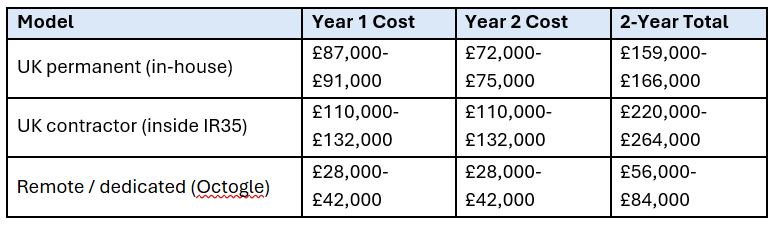
The two-year cost difference between UK permanent and a quality remote/staff augmentation model is in the range of £80,000-£110,000 for a single mid-level developer. For a team of three mid-level developers, that's £240,000-£330,000 — a meaningful amount of capital that could be doing other things.
What Drives Java Developer Cost Up or Down
Beyond the hiring model, several factors push the specific cost of your Java developer hire in one direction or the other.
Specialisation.
A Java developer with deep Spring Boot expertise and AWS cloud experience commands a premium over a generalist Java developer. If your project requires Kafka, Kubernetes, or specific enterprise integration frameworks, expect to pay the specialist rate. Trying to hire a generalist and upskill them is cheaper in salary and expensive in time.
Fintech/regulated industry premium.
Java developers with experience in financial services, healthcare, or other regulated industries routinely command 10-20% above market rate. The compliance knowledge is valued — and hard to acquire without domain exposure.
AI-native development capability.
This is the emerging differentiator that hasn't yet fully priced into the market but will. A Java developer who can demonstrably operate AI-assisted development workflows — code generation, AI-driven testing, AI code review — produces materially more output per day than one who can't. As the data on this becomes clearer, it will price into market rates. Right now, it's an edge that forward-thinking employers can build without paying extra for it — by choosing the right hiring partner.
London vs. elsewhere.
The geography premium is real. If your team is genuinely remote-first and location doesn't matter to delivery, paying London rates for a non-London developer is an avoidable cost.
What Should You Budget for a Java Developer?
That depends on what you need and when.
If you're building a senior technical function for the long term and cultural integration deeply matters — UK permanent hire, scoped realistically with full employment cost budgeted.
If you need a specific capability for a defined project timeline — UK contractor, with proper IR35 assessment.
If you need to scale your Java development capacity quickly, efficiently, and cost-effectively without compromising on quality — dedicated remote developers via a staff augmentation partner that vets properly and manages continuously.
Most growing UK companies with technical teams eventually end up using a blend: senior technical leadership hired locally, development capacity scaled through embedded remote talent. This model gives you the cultural anchor of a UK-based technical leadership while accessing the cost efficiency and speed of global talent for execution.
How Octogle Approaches This
We provide dedicated Java developers to engineering teams across the UK, UAE, and US — mid-level and senior, embedded directly into your team, operating within your stack and your processes.
Every developer goes through our multi-stage technical vetting — assessments, coding challenges, communication evaluation — and our proprietary AI bootcamp before they join a client team. They arrive ready to contribute, not in a ramp-up phase. Time to embed is two weeks, not six months.
Monthly retainer model. No employer NI. No pension administration. No recruitment fee. Instant replacement guarantee if a developer doesn't work out.
For teams that are serious about scaling their Java capability without the overhead and timeline of UK hiring — let's have a practical conversation about your stack and what you actually need.